

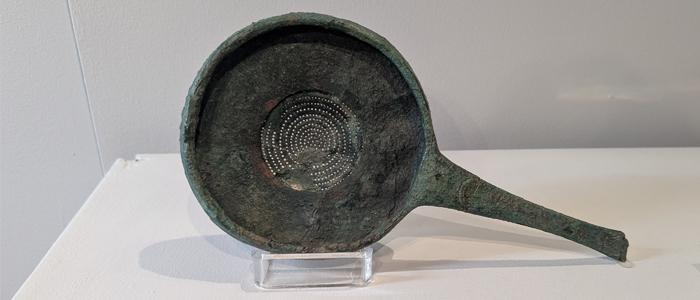
The MAM (Archaeological Museum of Murcia) and Villajoyosa Town Council have agreed on the temporary loan of the Etruscan bronze strainer from the Vilamuseu collection.
This bronze strainer comes from the Campania region in southern Italy and dates from the 6th century BC. It features a central bowl with a base meticulously perforated to form concentric circles, and a handle decorated with lines of dots forming two motifs: an ivy leaf at the end and a teardrop-shaped design next to the bowl. At the end of the handle, the remains of a ring for suspending the piece are still visible. The ivy leaf is not merely a decorative motif: it was believed that this plant acted as a kind of antidote to the effects of alcohol.
This extraordinary piece was found in the tomb of an adult female in the Poble Nou necropolis, accompanied by two pieces of Attic Greek pottery, a gold ring and a bronze brooch, which formed part of her grave goods—that is, the objects the deceased had owned in life and which had been buried with her.
This type of strainer was used by the Etruscan and Greek civilisations at funeral banquets to filter wine from the amphora into large bowls called krater, where it was mixed with water and other ingredients, to be served from there into cups or jugs at the banquets.
The wealth of Vilamuseu’s archaeological collection means that items are frequently loaned out for exhibitions in other Spanish cities and even abroad, at the request of other museums and organisations. On 29 April, the strainer was loaned out from Vilamuseu’s collection for the third time, this time to feature in the exhibition “Banquetes. Los ritos del vino entre iberos, griegos y romanos” (Banquets. The Rites of Wine among the Iberians, Greeks and Romans), which opened yesterday, 7 May, and will run until the end of September this year.
It is a temporary exhibition produced by the Archaeological Museum of Murcia, in collaboration with other Spanish museums, including Vilamuseu, which has contributed this exceptional piece, essential to the narrative of the exhibition.