
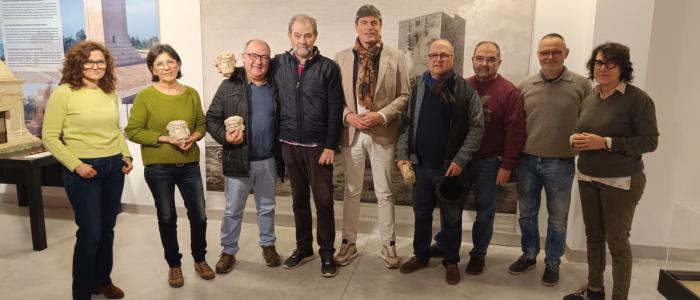
The Ruiz Soler family deposited the piece in Vilamuseu in 2017, where it has remained on display, and now the siblings Pablo, Lluís, Carlos, Pedro and Mar Ruiz Soler are donating it to the museum as part of its permanent exhibition. The donation was signed at a event presided over by the mayor of La Vila Joiosa, Marcos Zaragoza.
This piece, which is of great importance to the archaeology of La Vila Joiosa and the Valencian Community, has belonged to the Ruiz Soler family for as long as they can remember, but curiously, until very recently, its provenance was unknown. Just a few months ago, researcher Agustí Galiana informed the museum of the existence of ancient documents that mention it. The first mention of it comes from a manuscript by Juan Linares in the mid-19th century, which refers to ‘a stone head with an Asian turban, which today exists in the Barbera de D. Vicente Galiana’. The ‘turban’ refers to the crown of ivy and a headdress of ribbons that these pieces usually wear, which give them this appearance and are typical of the god Bacchus. Teodoro Llorente was the first to publish it, in 1889: a ‘white marble bust of a bearded man, smaller than life-size, embedded in the wall of the estate of D. Ignacio Galiana, in the district of La Barbera, near the sea.’
These references undoubtedly correspond to Pedro Ruiz's Barbera, an old farmhouse that stood next to the cliff above Vila beach, on whose wall the piece hung for more than a century. This large house, which no longer exists, belonged to the Ruiz Soler family. The Ruiz Soler brothers recall various anecdotes about the piece, such as that it was indeed located on the wall behind a door, which would hit it when opened, causing it to lose its nose.
The herms originally represented the god Hermes, from whom they take their name. In Rome, they often represent Bacchus, the god of wine. The crown of ivy leaves is related to this: the Romans believed that this plant was an antidote to drunkenness. Furthermore, it is a climbing plant, like the vine itself, and therefore symbolised the untamed and wild side of nature, growing freely over trees. It also symbolises eternal life, as it remains green even in winter, and this is related to Bacchus as he is “the god who dies and is reborn” or “the twice-born god”. In addition, these small pillars, called ‘herms’, were used to ward off evil spirits, and to reinforce this protection, they often included a penis halfway up the pedestal.
In the Roman Empire, herms were used to decorate gardens, courtyards or main rooms in stately homes, or some areas of public buildings, such as baths or theatres. In this case, it was probably located in the large Roman imperial villa of Barberes Sud, a short distance from Barbera de Pedro Ruiz, perhaps in the garden surrounded by columns and rich wall paintings that has been documented in recent excavations of the villa. The piece can be dated to the second half of the 1st century AD, when this type of herm was in vogue.